Healthy Homes
Together, APEN, our members, and working-class immigrant and refugee families across California have been fighting for quality, affordable, and healthy housing for all.
APEN’s Healthy Homes advocacy is rooted in our vision of strong, sustainable local economies that are only possible if people can stay in their homes without the risk of rising energy costs, skyrocketing rents, and hazardous living conditions.
Our frontline communities have felt the effects of the fossil fuel industry worsening the air in the homes we hold sacred. Pollution from oil and gas doesn’t just impact our neighborhoods, it threatens our climate with intensifying extreme weather. As we organize against refineries and for a just transition from fossil fuels, we look into our homes to eliminate harmful exposures and reduce our climate impact. Our Healthy Homes program aims to make sure our communities can access electrified appliances and their health, affordability, and climate benefits.
The Equitable Building Decarbonization program directs existing state energy efficiency funds to improve habitability in the places that need it most —neighborhoods with the highest rates of pollution and poverty. This program provides free building and appliance upgrades that make our homes healthier, more comfortable, and better for the planet, at no cost.
Equitable Building Decarbonization
APEN is an outreach partner for the state’s Equitable Building Decarbonization (EBD) program. This program secures funding for free building upgrades to improve access to electric appliances and their benefits for a just transition. 1.19.24: Solar in Multifamily Affordable Housing (SOMAH) workshop at St. Mary’s Garden held by APEN
APEN supports eligible tenants and homeowners to prepare their applications and follow up with them throughout the process.
How To Apply
To receive more information for this program, please submit your information here for our Healthy Homes Organizer to follow up about next steps and energy affordability resources, regardless of your eligibility.
You can learn more about the program at Association for Energy Affordability or contact Kieran Tran at healthyhomes@apen4ej.org.
Eligibility
- Be a single-family home, multifamily building, or manufactured/mobile home.
- Be located in Richmond or Oakland, specific census tracts will be screened by APEN
- Be built before January 1, 2020.
- Use natural gas, propane, or another fossil fuel as the primary fuel for space heating or water heating.
- For single family and manufactured/mobile homes, the home must be occupied by a low-income household.
- For multifamily properties, at least two-thirds of units must be occupied by low-income households.
Benefits
The EBD program provides full project support that includes assistance in identifying the best upgrades for your property and uses certified contractors to install the following types of measures:
Electrification of appliances:
- Heat pump HVAC or heat pump water heater *required to upgrade one
- Electric dryer
- Induction stove
Installation of eligible energy-saving measures
LED lighting
- Low-flow faucets/showerheads
- Air sealing
- Smart thermostat
Minor safety repairs and electrical upgrades
- Electrical wiring and panel upsizing
- Remediation (i.e. lead paint, mold, asbestos, ventilation)
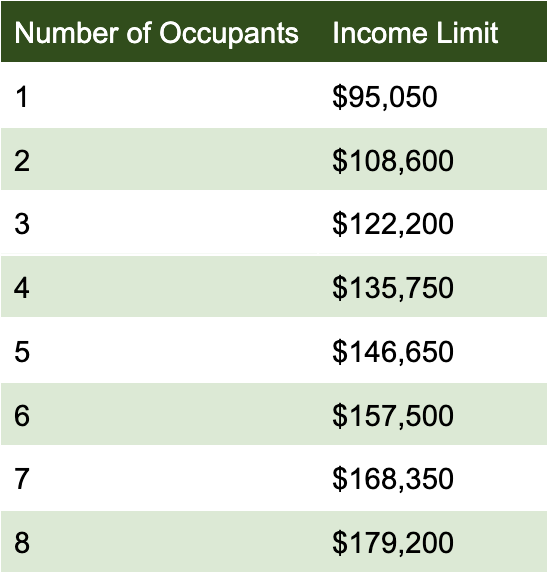
Household income is assessed using area median income (AMI). 80% Area Median Income and below is considered a low income household. For example, below is the area median income chart for Alameda and Contra Costa County in 2025. Participation in qualifying assistance programs such as SNAP or WIC can also be used to determine eligibility.
What’s next?
Once you submit the interest form, APEN staff will follow up with next steps such as contacting the property owner and preparing your application. A home assessment will be conducted by program administrators and qualified contractors to determine the best options for appliance and building upgrades.
After the home assessment, if the property owner wishes to proceed with the retrofit, the regional administrator will schedule qualified contractors to complete the work. All work will be done at no cost to the property owner.


Home Electrification

Building upgrades include electric cooking and laundry appliances, heat pumps for water heating and air conditioning, and more, all at no cost to tenants and property owners. Program administrators and qualified contractors will help identify and agree upon appropriate retrofit measures for your unique home. The program pays for the equipment, installation, and labor costs.
Induction Stoves
 An induction cooktop uses electromagnetism to create heat inside the cooking pan, which in turn heats the food or water. Induction cookstops stay cool while in use because only the cooking pan has heat which can improve kitchen safety. Only pans that can carry a magnetic field will work on the induction stove. Induction stovetops are more energy efficient and can reach temperatures more precisely than gas stoves. Faster heating and temperature control can improve users’ cooking experience.
Heat Pumps
Heat pumps can be used for water heaters, air conditioner/central heaters (HP HVAC), and laundry. A Heat pump uses a small amount of energy to move heat from one location to another. Gas heaters use gas to generate heat while a heat pump is powered by electricity and moves existing heat inside or outside the units, making it very energy efficient. Heat pump heat, ventilation, and air conditioning (HVAC) combines a furnace and air conditioning function into one system. Below are examples of how heat pumps work to heat water and provide temperature control indoors.
Other Energy Bill Assistance and Weatherization programs
Incentive Finders
Switch Is On: Switch Is On is a statewide outreach and education campaign that has an extensive website to help homeowners understand electrification and connect to contractors and rebates.
Ava Community Energy: Ava includes energy initiatives and resources from Alameda County and the San Joaquin Valley.
MCE Energy: MCE includes energy initiatives and resources from Contra Costa, Marin, Napa, and Solano Counties.
Energy Bill Assistance
California Alternate Rates for Energy (CARE) Program: CARE is a state program that provides a 35% discount for electricity and a 20% discount for natural gas to qualifying low-income households.
Family Electric Rate Assistance (FERA) Program: Families whose household income slightly exceeds the CARE allowances may qualify to receive FERA discounts, which applies a 18% discount on their electricity bill.
Relief for Energy Assistance through Community Help (REACH): REACH provides an energy credit for up to $300 based on the past due bill (energy credit support is subject to funding availability). PG&E contracts with Dollar Energy Fund to accept and process assistance requests for the PG&E REACH program.
Arrearage Management Plan (AMP): CARE or FERA recipients may be eligible for up to $8,000 in debt forgiveness through AMP.
Marin Community Energy Cares Credit : CARE or FERA recipients may receive a $20 monthly discount, and small and medium-sized businesses may receive a $25 monthly discount on electricity bills through March 2026.
Weatherization
LIHEAP (Low Income Home Energy Assistance Program): LIHEAP Weatherization provides free energy efficiency upgrades to low-income households to lower their monthly utility bills while also improving the health and safety of the household’s occupants. It includes the Home Energy Assistance Program (HEAP) provides one-time financial assistance to help balance an eligible household’s utility bill.
Marin Community Energy Home Energy Savings and Energy Savings for Multifamily Properties
- MCE’s Home Energy Savings program provides qualifying single-family homeowners and renters with a home-energy assessment, upgrades that may increase your home value and lower your energy bill.
- For multifamily properties, eligible property owners can receive up to $6,000 per unit for upgrades, comprehensive assessments, and technical assistance for electric, energy- and water-saving measures.
Weatherization (Contra Costa County): The Weatherization Program will test your gas appliance(s) to determine if they are operating properly and safely. Any gas appliances that fail the inspection will be repaired or replaced. In addition to the appliance inspection, the inspector will conduct an evaluation of the home to determine what energy-saving measures are needed.
Efficiency And Sustainable Energy (EASE) Home Program: EASE Home provides funds and installation to make essential improvements, like insulation and duct-sealing, more accessible for moderate-income households.

