
KQED: Public Safety for Asian Americans Starts with Nurturing Our Communities
By Eda Yu
An “89-year-old grandma, who was brutally attacked on San Francisco playground, dies 1 year later,” read the ABC7 News headline from January 2020. At the time, COVID-19 had only recently arrived in the United States, and I’d stumbled upon the article while trying to learn more about a video I’d seen circulating of an elderly Asian man who was harassed and assaulted while collecting cans in San Francisco.
Since the pandemic began, many of us (myself included) have held former President Trump’s xenophobic rhetoric responsible for the surge in anti-Asian sentiment and violence across the country. His comments calling the novel coronavirus a “Chinese virus” or “Kung Flu” for which the U.S. should “[make] China pay” have undoubtedly poured fuel on the flame. But reading about the 2019 attack on a grandmother reminded me of a haunting, unshakeable truth: This anti-Asian violence is nothing new.
Since the first wave of Chinese laborers arrived in the U.S. in the 1850s, Asians in America have occupied the role of “perpetual foreigners” and been subjected to violence and animosity for our existence as “outsiders” in this country. Despite some recent attention, in general, that history isn’t commonly taught. Few people know, for instance, that the Chinese Massacre of 1871 in Los Angeles was the largest mass lynching in U.S. history, or that most of San Francisco’s Chinatown was burned down during the Riots of 1877—when mobs of white laborers stormed the neighborhood, burning buildings and killing Chinese workers in anger that they were taking over the workforce.
It doesn’t matter how many years have passed, or how well white elites say Asians have integrated into America’s cultural fabric. The sentiment that we do not belong in this country always returns in times of crisis or socioeconomic hardship. And in the Bay Area, a space heavily impacted by meteoric gentrification and the constant threat of displacement, that state of crisis can feel constant for many communities.
That 89-year-old grandmother I read about was Yik Oi Huang. In January 2019, she was brutally attacked while doing her daily morning exercise at a park in Visitacion Valley in an attempt to rob her house across the street. She was kept on life support until early 2020, when she ultimately passed away from her injuries. That same year, three elderly men in San Francisco Chinatown were also violently beaten and robbed.
Even now, writing about these attacks leaves me with feelings that are hard to parse. On one hand, there’s the grief—the mourning for those who suffered and those who’ve passed, something we’ve faced over and over again this year. Then there’s the rage. And beyond that is a deep-rooted despair at the system that’s failed our most vulnerable, and how little we’ve done to stop it.
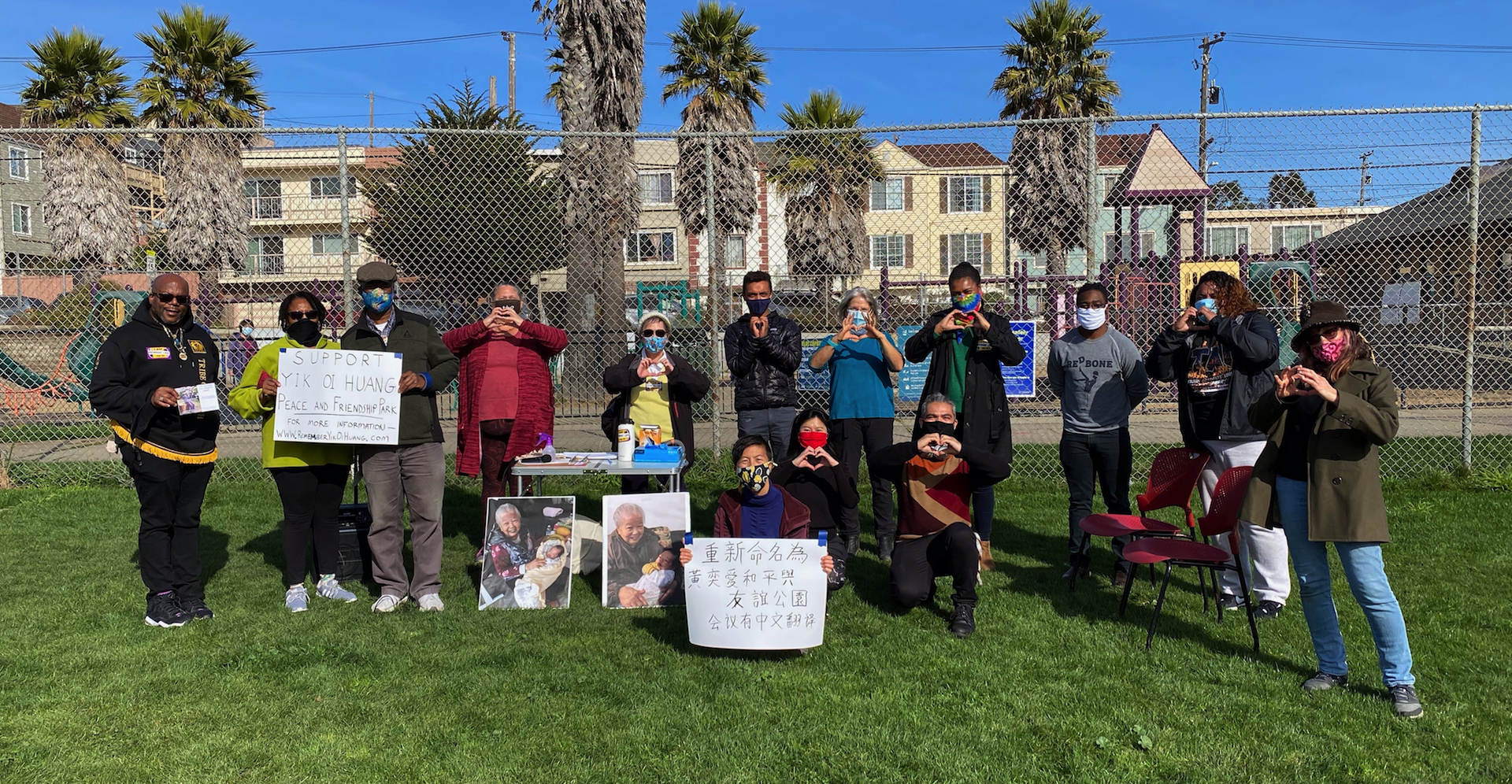
In spaces ruptured by extreme wealth inequality and displacement, it can be hard to find community. Sometimes, like in our current moment, it takes a moment of crisis to come together and build. Sasanna Yee, the granddaughter of Yik Oi Huang, felt similarly after what happened to her grandmother in 2019: “Four days after her attack, I hosted and organized a healing through solidarity and song event for the community, so that we don’t have to carry this pain in isolation,” she tells me. “There was a Black community leader named Ronald Colthirst, and he was so moved by the compassionate and collaborative nature of my work that he suggested having the park renamed [to Yik Oi Huang Peace and Friendship Park].”
His idea sparked a movement. Since then, Sasanna has held many gatherings and activities, like yoga or sound meditation, to foster an environment of shared safety and healing in a space that’s been tainted with trauma. “Just a couple of weeks ago, two elderly [Chinese] women came up to me and said, ‘We walked the park with your grandmother for 20 years—it could have been any of us. We were devastated to hear about her loss,’” she recalled. “They were asking if there would be more gatherings, [since we met over Zoom during COVID] so that they could feel safe, like they could use the area in peace.”
Sasanna started the nonprofit Communities as One in January of 2020 to support these events and efforts to rename the park. Working in collaboration with a landscape architect, a community gardener and Colthirst, she hopes to add street lights and seating, as well as long-term programs that work towards building multigenerational and multicultural relationships. The focus group—which has been working since May 2020 to collect signatures and letters of support for the park renaming—is “very close” to submitting the proposal to the San Francisco Recreation and Parks Commission.
“That’s what I’ve learned through all this,” Sasanna said. “It’s such a blessing because if it weren’t for my grandmother, I would probably still be in isolation doing my own thing but because of [what happened], you really need community.”
Ultimately, building community and investing in our neighborhoods are crucial elements of how Bay Area organizers work to create public safety. Oakland-based Asian Pacific Environmental Network (APEN), a member of the Oakland Chinatown Coalition and a leader in the current organizing movement, focuses on exactly that through their Chinatown Ambassadors Program. Founded in 2017, briefly paused due to COVID in 2020 and reinstated in 2021, the program centers neighborhood beautification, relationship-building with merchants and providing assistance for customers and residents. Originally designed as a partnership with the re-entry population, the program doesn’t depend on volunteering, which can be inconsistent. Instead, it offers formerly incarcerated folks job training opportunities—creating a sustainable, long-term framework for public safety that can also scale up through volunteers in moments we need rapid response.
“I think for places like Chinatown, and I would also probably argue for Little Saigon as well, one thing to be said is ‘How does your physical environment allow you to feel safe and welcome?’” asked Alvina Wong, APEN’s campaign and organizing director. In addition to interacting with local merchants and visitors, Chinatown Ambassadors pick up trash and clear graffiti. They engage with unhoused people or those who seem lost. They file city complaints for issues like illegal dumping or cracked sidewalks. And they even put up decorations to celebrate Chinatown and breathe life into the space.
Similar to Sasanna’s work in Visitacion Valley, Wong feels that focusing on improving the neighborhood’s physical environment can help folks “feel a little bit more safe, to feel a little more investment that there are people looking out for you.” She continued: “Beautification isn’t just about cleaning—it’s also about using art and community to create space. Even in having space to do Tai Chi or fan dancing or play badminton—where do we actually get to infuse more of our culture? How do we allow for the environment and the space to feel alive and welcoming?”
