
NPR: As Rising Heat Bakes U.S. Cities, The Poor Often Feel It Most
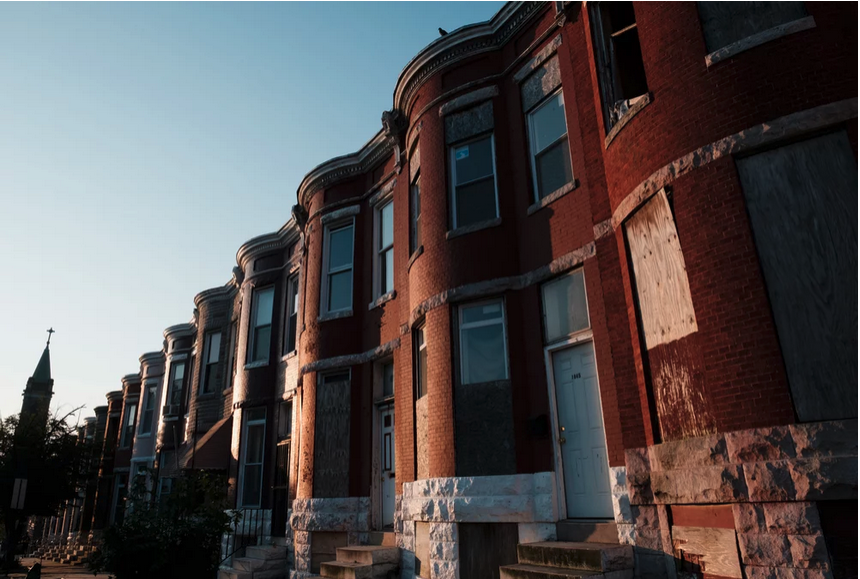
Baltimore’s Franklin Square neighborhood is hotter than about two-thirds of the neighborhoods in the city. It’s also in one of Baltimore’s poorest areas. Ian Morton for NPR
By Meg Anderson, Sean McMinn
Excerpts:
“When Shakira Franklin drives from West Baltimore to her job near the city’s Inner Harbor, she can feel the summer heat ease up like a fist loosening its grip.
“I can actually feel me riding out of the heat. When I get to a certain place when I’m on my way, I’ll turn off my air and I’ll roll my windows down,” says Franklin. “It just seems like the sun is beaming down on this neighborhood.”
Franklin isn’t imagining that. Her neighborhood, Franklin Square, is hotter than about two-thirds of the other neighborhoods in Baltimore — about 6 degrees hotter than the city’s coolest neighborhood. It’s also in one of the city’s poorest communities, with more than one-third of residents living in poverty.
Across Baltimore, the hottest areas tend to be the poorest and that pattern is not unusual. In dozens of major U.S. cities, low-income neighborhoods are more likely to be hotter than their wealthier counterparts, according to a joint investigation by NPR and the University of Maryland’s Howard Center for Investigative Journalism.
Those exposed to that extra heat are often a city’s most vulnerable: the poorest and, our data show, disproportionately people of color. And living day after day in an environment that’s literally hotter isn’t just uncomfortable, it can have dire and sometimes deadly health consequences — a fact we found reflected in Baltimore’s soaring rates of emergency calls when the heat index spiked to dangerous levels.
According to a Howard Center analysis of U.S. census data and air temperature data obtained from Portland State University and the Science Museum of Virginia, the hottest neighborhoods in Baltimore can differ by as much as 10 degrees from the coolest.
And Baltimore is not an extreme case. NPR analyzed 97 of the most populous U.S. cities using the median household income from U.S. Census Bureau data and thermal satellite images from NASA and the U.S. Geological Survey. In more than three-quarters of those cities, we found that where it’s hotter, it also tends to be poorer. And at least 69 had an even stronger relationship than Baltimore, the first city we mapped.
This means that as the planet warms, the urban poor in dozens of large U.S. cities will actually experience more heat than the wealthy, simply by virtue of where they live. And not only will more people get sick from rising temperatures in the future, we found they likely already are.”
“It’s also not unusual, Stone says, for poorer areas to be located near “undesirable land uses” such as nearby highways or industrial areas, which create even more heat.
The pattern of who lives closer to those sources of heat is not just a matter of poor versus rich, it is also often a matter of black and brown versus white. Nationwide, many of the low-income communities NPR found to be hotter — often with fewer trees, more concrete and closer to highways and factories — are also communities of color.
“It wasn’t just a coincidence that communities of color end up in some of the most undesirable places,” says Miya Yoshitani, executive director of the Asian Pacific Environmental Network, which focuses on environmental justice issues affecting working-class Asian and Pacific Islander immigrant and refugee communities.
Yoshitani explains that policies like redlining — a practice, beginning in the 1930s and banned by the Fair Housing Act in 1968, in which neighborhoods were marked high risk for mortgage lenders in large part based on their racial makeup — forced people of color into less desirable areas. In Baltimore, the city’s hottest neighborhoods, many of which are predominantly African American, still line up fairly consistently with the neighborhoods marked “hazardous” on a 1937 map created by the Home Owners’ Loan Corp.
“People of color, African American communities, indigenous communities in the beginning and then immigrant communities as they came to the United States were not given a choice about where they could live, where they could raise their families, where they could work,” Yoshitani says. “Those choices were made for them and that legacy continues today.”
